About
"I'd like to be remembered as a hands-on producer who always worked closely with the writer, closely with the director, who always had tried to achieve the vision that I had of the picture combined or adjusted with the vision of the director, so that there's one vision between us. And as much as possible, to make pictures that were entertaining and positive."
In his nearly two-and-a-half-hour interview, producer Stanley Rubin (1917-2014) talks about his early years in the entertainment business working in the mailroom at Paramount Pictures and as a reader for several studios, including Universal. He speaks of his transition to screenwriting and ultimately producing, which began with the now-classic film noir, The Narrow Margin (1952). He details his first work as a producer in television, on the dramatic anthology series Your Show Time. He discusses the creation of the pilot (which he co-wrote and co-produced with Louis Lantz), the shooting schedule of the series, and the source material that was used for the episodes. He also describes the experience and significance of winning the first Emmy award ever given to a "film made for television," which he accepted at the very first Emmy Awards on January 25, 1949. Rubin outlines his other credits as a television producer, including the series The General Electric Theater and Bracken's World, and the television movie Babe. B-roll consists of Rubin holding his 1949 Emmy and talking about the win, as well as still photos from Your Show Time, a promotional brochure from Your Show Time, the script cover of "The Necklace" (the pilot of Your Show Time), a 1949 photo of Rubin holding his Emmy award, two photos from The General Electric Theater, and other photos representing his career. Gary Rutkowski conducted the interview on June 17, 2004 in Century City, CA.
Highlights

Stanley Rubin on winning the first Emmy Award ever to awarded a "film made for television" for Your Show Time at the first Emmy Awards ceremony on January 25, 1949

Stanley Rubin on joining the Screenwriter's Guild and helping to negotiate the first minimum basic agreement
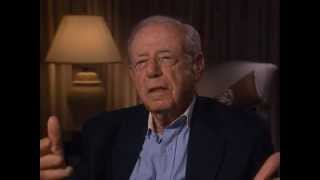
Stanley Rubin on Ronald Reagan as host of General Electric Theater
Stanley Rubin on not being allowed to select stories written by Russian authors for Your Show Time
Stanley Rubin on serving in the Motion Picture Unit during World War II
Full Interview
Chapter 1
On his early years and influences; on attending UCLA; on getting a job in the newspaper business
On magazine writing and breaking into writing for the movies in the 1940s; on working in the Story Department at Paramount and writing his first screenplays
Chapter 2
On joining the Screenwriter's Guild and helping to negotiate the first minimum basic agreement; on serving in the Motion Picture Unit during World War II; on writing the movie "Decoy"
On his first work as a producer in television, the dramatic anthology series Your Show Time.; on the pilot episode, "The Necklace" (which he co-wrote and co-produced with Louis Lantz) and the show's actors and host
Chapter 3
On the source material, directors, and producers for the anthology series Your Show Time; on the show's shooting schedule, budget, and syndication rights
On favorite episodes of Your Show Time; on the formation of the Television Academy and the Emmys; on winning the first Emmy Award ever awarded to a "film made for television" at the first Emmy Awards ceremony on January 25, 1949
On returning to writing movies and writing "The Narrow Margin"
Chapter 4
On producing feature films, including "The Narrow Margin"; on producing CBS' Peck's Bad Girl and Hotel De Paree; on the Hollywood Blacklist
On producing General Electric Theater and the show's cancellation (the only way the show could get rid of Ronald Reagan as host); on producing The Ghost and Mrs. Muir and Bracken's World
Chapter 5
On working with Eleanor Parker on Bracken's World; on producing The Man and the City
On his work in the 1970s, including the television movie Babe
On some of his favorite movie work; on advice to an aspiring producer; on how he'd like to be remembered
On his Emmy statue for Your Show Time; on B-roll photos from his career